Work Memory Interviews

Capture how work really happens.

An agent interviews the people who know the exceptions, shortcuts, decision rules, and failure modes — asking each follow-up against what was just said. Their answers are compiled into permissioned memory objects that every other BiZaas surface can then reason over.

Command centerWork Memory included
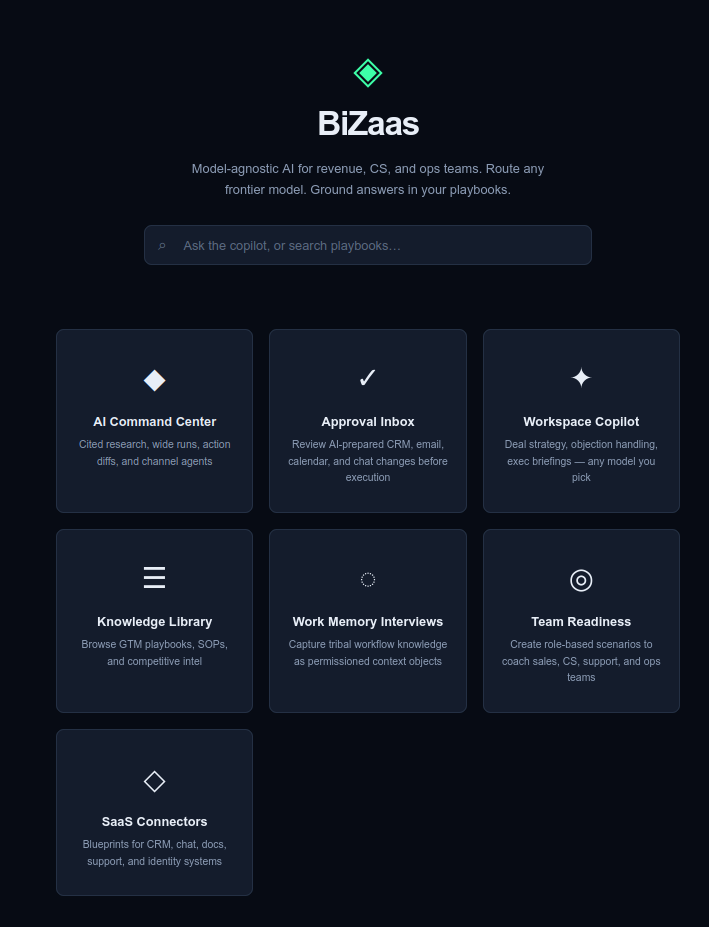
BiZaas command center with the Work Memory Interviews feature visible alongside approvals, copilot, knowledge library, team readiness, and SaaS connectors

Not transcripts. Structured operating memory.

A transcript is another corpus nobody searches. What makes captured knowledge an asset is the object it lands in: a typed claim carrying the expert’s own words as evidence, the conditions it holds under, what it relates to, who owns it, how confident it is, and when it must be re-checked.

01 / ELICIT

The agent asks the next question

It reads what your systems already document, then interviews around the gap — one question at a time, each follow-up written against the last answer. That is where the undocumented threshold and the real approver surface.

02 / COMPILE

Answers become typed objects

The transcript is split by claim, not by question, and each claim is classified: rule, exception, decision signal, handoff, or failure mode. Anything the transcript cannot support is not emitted.

03 / GOVERN

Trust metadata travels with it

Every object carries a verbatim evidence quote, an owner, a confidence grade, a permission tier, and a review date. Sensitive captures are tightened automatically rather than inheriting the session default.

04 / APPLY

Other agents get smarter

Captured memory enters retrieval directly. The Copilot, cited research, and readiness drills answer from it — permission-filtered per reader — and the coach turns it back into guidance for whoever is learning the workflow.
What one captured object looks like.

This is the unit of value. It is what an agent retrieves, what a reviewer audits, and what expires on a schedule if nobody re-confirms it.

EXCEPTION

Discount authority below 50k ARR

Statement. AEs may self-approve up to 20% on deals under $50k ARR; anything above either threshold routes to the deal desk lead.

Evidence. “Anything past 15 percent goes to me, but under 50k the AE can self-approve up to 20. That is not written anywhere.”

Owner. Deal desk lead · Confidence. High · Permissions. Internal · Review by. 90 days

Related. CPQ, deal desk queue, quarterly discount policy

COACH

Pointed back at people

Ask the coach how to run a workflow and it answers from captured memory only — leading with the exceptions and warning signs experienced colleagues named, citing each one, and telling you who to ask where the memory is thin.

It never grades the employee. Interviews are not performance evidence, and coaching is not assessment.

Designed for trust.

Employees will not share real judgment if the system feels like surveillance. BiZaas treats interview capture as operational knowledge, not performance review.

BOUNDARY

No performance scoring

Keep interview notes separate from HR review and individual evaluation.

CONFIDENCE

Mark uncertainty

Low-confidence captures carry their open questions and rank below verified sources in retrieval, so a hedge never reads as a rule.

PERMISSION

Scope access

Permission tiers are enforced at retrieval, not just recorded: a leadership-review capture never reaches a member’s copilot answer.

REVIEW

Keep it current

Every object carries a review date from the day it is captured, and the coverage view lists what is now due for re-verification.